Start with what is going wrong
Risk registers kept in spreadsheets, indicators updated by hand, board reporting rebuilt every quarter. These point to the capabilities that matter to your bank, and the ones you can ignore.


Software · ERM · Banking in Asia
In Asia, a shortlist built on features alone can send your team back to the start after months of research and demos.
Last reviewed: October 2026
Key takeaway
The best ERM software for a bank in Asia depends on more than features, and other constraints are easily missed, such as where the software can be hosted, whether it can be implemented onsite and whether support covers your business hours. These constraints grow when many software suppliers have limited offices in Asia. This page sets out the key considerations, so your team avoids shortlisting suppliers it may have to drop at a later stage.
The best enterprise risk management (ERM) software for a bank in Asia is the one that covers the risk functions the bank requires, can run where the bank needs it, and can be implemented and supported in its country. Many global suppliers sell across the region, but few have their own implementation and support teams in the bank's own country, and most rely on an implementation partner that carries only some platforms. The same considerations apply to insurers, asset managers and other financial institutions operating across Asia.
Risk registers kept in spreadsheets, indicators updated by hand, board reporting rebuilt every quarter. These point to the capabilities that matter to your bank, and the ones you can ignore.
Where the system may run, where data may sit and who can implement and support it locally. A product that fails one of these is out regardless of how well it scores on features.
A first system may prioritise a consistent risk register and workable board reporting. A replacement may also need group aggregation, local workflows and connections to existing risk and banking systems.
These six factors organise the main areas to assess when choosing ERM software for your bank. The considerations later on this page provide the detailed checks within each area.
Enterprise and operational risk workflows, including incidents, controls, technology risk and the reporting your board and regulators expect.
A supplier or partner that can implement and support the platform in each country where your bank operates.
A deployment model, data location and access arrangement that meet your bank's mandatory restrictions, separated from its preferences.
Encryption, sign-in controls, independent security evidence and tested recovery arrangements.
Connections to your existing risk and banking systems, and how much your own administrators can change without the supplier.
Relevant banking implementation experience, and how delivery quality is maintained if experienced people become unavailable.
For the detailed checks within each factor, continue to the key considerations further down the page.
A bank operating in several Asian markets rarely works in one language, under one regulator or with one way of approving work. Those differences reach the software too: what your teams need to record and review, where the system's data should reside, and where implementation and support come from. Many software suppliers have few offices in Asia, so implementation may be done remotely, support may come from another region and time zone, and the system and its data may be hosted in only a few countries in Asia. Those hosting options may not meet your internal policy or regulatory needs.
Local assessments and group reporting
Markets may need different assessment forms, approval routes and languages, while the group still needs one consolidated view of material risk.
Hosting and regional coverage
A supplier may sell across Asia but host in only a few countries, with support based elsewhere or provided through local partners.
Remote or on-site delivery
Some suppliers implement by video call. If you need on-site help with design, testing or training, confirm who provides it and from where.
For a fuller requirements exercise, see how to define ERM software requirements.
These eight suppliers are examples, not a shortlist. There are many more ERM suppliers in the market. These are listed alphabetically to show how suppliers differ on hosting, local presence and delivery.
Archer
Enterprise and Operational Risk Management
Covers enterprise and operational risk in one solution family, with a shared risk catalogue and assessment methods applied across business units.
Business user interface
A lighter interface for staff outside the risk team to submit risk information and complete assessments without learning the full platform.
Consistent assessment methods across business units
One set of assessment methods and workflows applied across units, so subsidiaries rate risk the same way and group reporting holds together.
Risk catalogue with named ownership
A central record of enterprise risks, each with an accountable owner, so assessments and reporting trace back to one source.
Check before shortlisting
Configurability is the main driver of the implementation timeline here, so agree the scope, who does the configuration and over what period before committing. Delivery runs through a partner, so confirm which partner covers your countries and its experience with this product in a bank.
MetricStream
Enterprise Risk Management
Built around a connected data model, so business objectives, processes, risks and controls are linked rather than held as separate registers.
Linked risk and control model
Ties objectives, processes, risks and controls together, so a control failure can be traced to the objective it affects.
Multi-dimensional assessments
Runs qualitative and quantitative assessments against configurable parameters with weighted scoring.
Indicator monitoring with automated feeds
Pulls indicator data from source systems rather than relying on manual updates, and alerts owners when thresholds move.
Check before shortlisting
Mapping your objectives, processes, risks and controls is the main setup effort, so agree who does that work before the first assessment runs. Delivery is direct from the supplier, so establish where the delivery and support team sits relative to your markets and in which time zone.
Protecht
Risk Management
Keeps the risk picture current by linking the register to incidents, controls and indicators as they change, rather than between assessment cycles.
Live risk scoring
Updates risk health scores as linked incidents, indicators and control tests are recorded.
Bow tie analysis
A visual tool for mapping causes, controls and consequences around a single risk event.
Central risk taxonomies
Shared libraries of risk events, causes and controls, so business units record the same risk the same way.
Check before shortlisting
Its only recorded office in the region is in Australia, so establish who would implement and support you in your own country and in which time zone. Cloud hosting only is recorded, so rule this out early if your bank requires on-premises deployment. If your teams need to record risk away from a desk, check what the mobile app can do without a connection.
Resolver
Enterprise Risk Management
Aimed at producing board-ready risk reporting from standardised assessments, with risk appetite built into the assessment itself.
Risk appetite in the workflow
Appetite statements sit inside the assessment, so a risk owner records exposure against the stated tolerance rather than in a separate exercise.
Configurable risk scoring
Both qualitative and quantitative methods, tailored to how your bank describes and rates risk.
Issue reporting framework
A standard route for raising and remediating issues across business functions, with ownership tracked to closure.
Check before shortlisting
Cloud hosting only is recorded, so rule this out early if your bank requires on-premises deployment. Reporting quality depends on how consistently risk owners describe risks, so ask how the platform keeps entries comparable across business units.
Riskonnect
Enterprise Risk Management
Brings risk data held by separate departments into one current view for leadership, with quantitative modelling available alongside rated assessments.
Bow tie analysis
Maps the causes, controls and consequences around a single risk event in one view.
Indicator monitoring with alerts
Tracks risk and performance indicators together and alerts owners when a limit is breached.
Consolidated leadership view
Pulls risk records held by different departments into a single current picture for senior management.
Check before shortlisting
Breadth of configuration can require specialist technical input and extend the deployment, so agree who provides that and when. Cloud hosting only is recorded. Its regional teams sit across four countries, so confirm which one would serve your bank and in which time zone.
SAI360
Enterprise and Operational Risk Management
Holds enterprise oversight and operational risk work in one register, so frontline records and the board view draw on the same data.
Top-down and bottom-up assessments
Supports executive-level risk identification and frontline operational assessments in the same system, with both feeding one view.
Connected risk register
Links related risks, incidents and controls automatically, so a record does not sit in isolation once something changes.
Indicator monitoring across systems
Tracks risk indicators drawn from several operational systems rather than from the risk team's own entries.
Check before shortlisting
The initial build is where the effort sits, because so much is configurable, so agree the scope and the people before committing. Cloud hosting only is recorded, so rule this out early if your bank requires on-premises deployment.
SAP
SAP Risk Management
Designed to sit against a bank's existing SAP landscape, drawing risk information from transaction systems rather than from assessments alone.
Risk hierarchy with appetite and owners
Defines the risk structure across the group, assigns appetite at each level and names the owner for each risk.
Risk monitoring with root cause records
Tracks incidents, records why they happened and documents how risks relate to one another.
Monitoring from transaction data
Reads application data in underlying systems continuously, so indicator movement comes from live operations rather than periodic entry.
Check before shortlisting
Its value depends on how much of your bank already runs on SAP, so establish what it delivers if your core systems are not SAP. Tailoring workflows takes real technical expertise, and delivery runs through a partner, so confirm which partner covers your countries.
ServiceNow
Risk Management
An oversight layer over the wider ServiceNow platform, so risks connect to the IT services, assets and incidents the bank already records there.
Business goals linked to operational risk
Connects stated objectives to the underlying risks that would prevent them, so the board view traces down to operational records.
Risk linked to IT services and assets
Risks and controls attach to the services and assets already held in the platform, so technology risk is assessed against the live estate rather than a separate list.
Executive risk views
Consolidates risk types into a current picture of exposure for leadership to prioritise against.
Check before shortlisting
An executive risk view is only as reliable as the frontline data feeding it, so check how the platform keeps first-line reporting complete. The product is sold in packaged tiers, with some risk functions and third-party risk sitting outside the core packages, so confirm exactly which functions are in the tier you are quoted. Delivery runs through a partner, so confirm which partner covers your countries.
* Self-hosted deployment may be available through a separate arrangement rather than the standard cloud subscription.
For certainty, confirm any critical points in the supplier details above directly with the supplier.
Centvra matching
Research every supplier yourself, or start from a shortlist you can justify.
Describe your requirements in a sentence or two. Centvra reads your context and prepares a curated set of questions tailored to your bank. It then scores each supplier in our catalogue against your answers with Centvra's proprietary scoring model, built specifically for GRC software selection, and explains why each one on your shortlist fits, so you can show how the shortlist was reached.
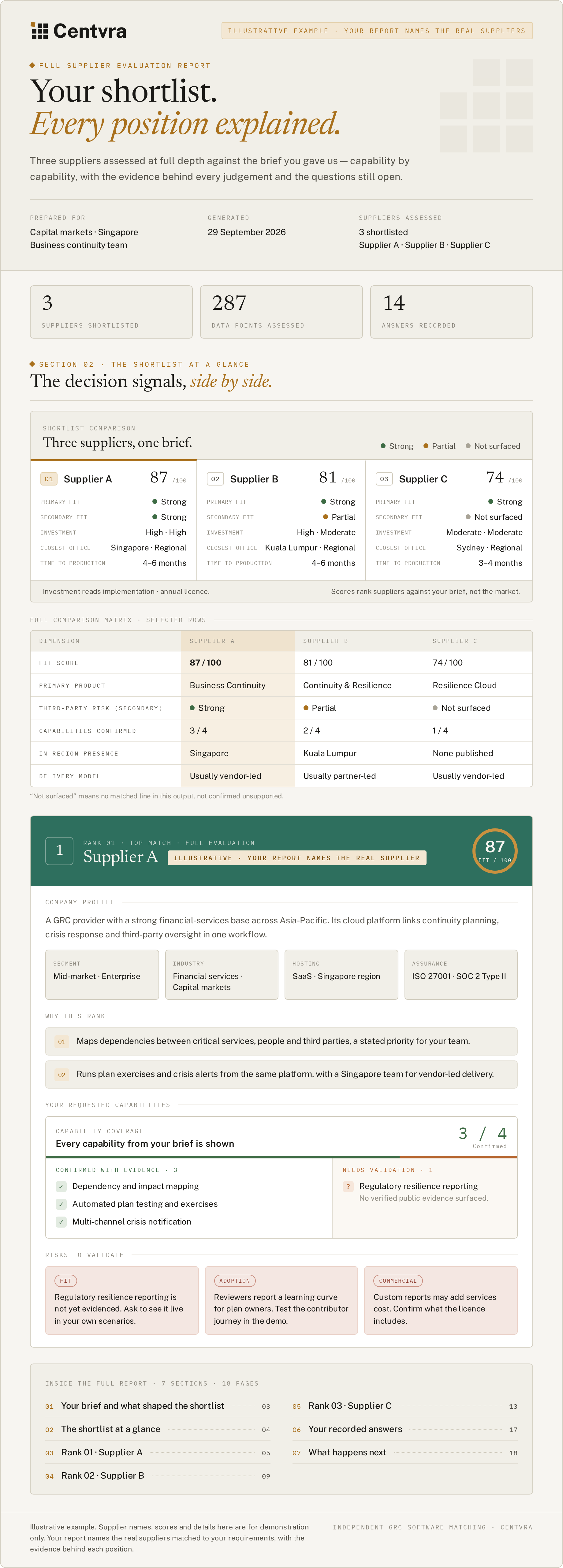
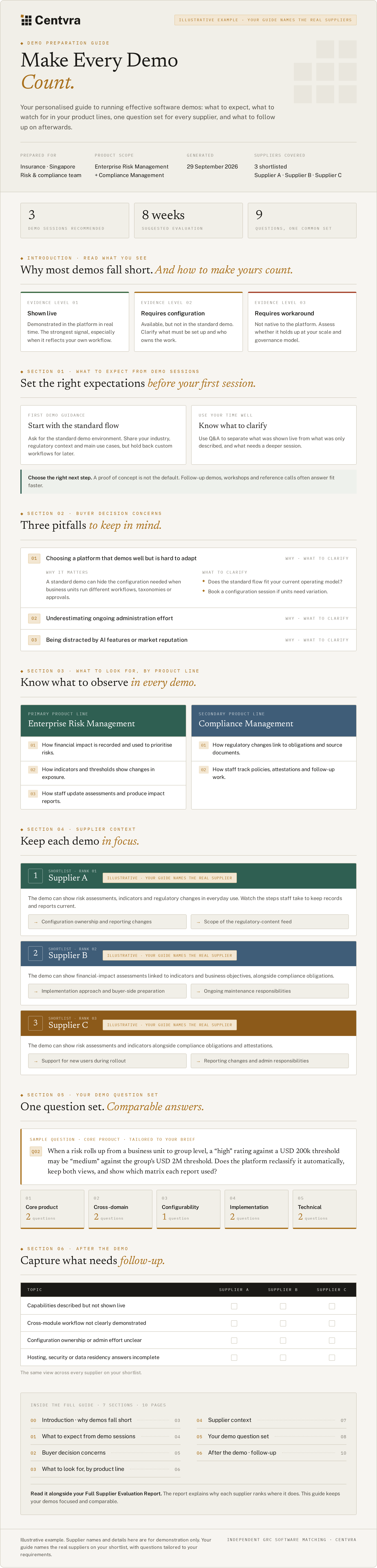
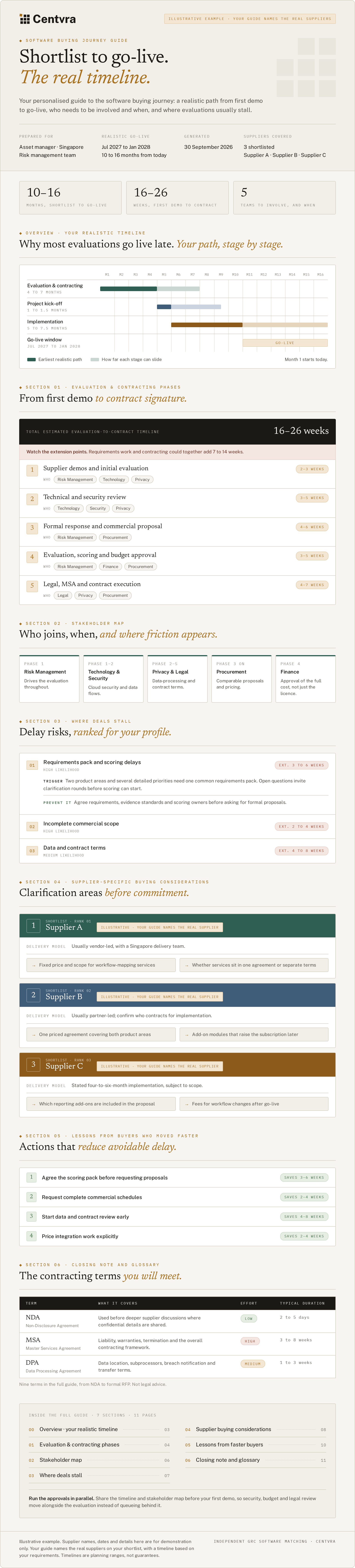
With your shortlist, you can also receive these. Click one to preview it.
Several of the products above are sold as enterprise and operational risk management, and others as one or the other. The two are connected but not the same, and how a supplier packages them decides what you are actually buying.
A bank may run separate enterprise-risk and operational-risk teams, or place operational risk inside a broader risk function. Separate teams do not by themselves require separate software.
Operational risk needs detailed assessments, incident and loss records, control reviews and remediation. Enterprise oversight needs a consolidated view of material risk, appetite and reporting for decisions.
Some sell separate applications on a shared platform, others combine both in one solution. Check what the proposed package includes and what needs configuration or extra components.
Where both functions need support, examine how the information connects. An operational incident should be traceable to the relevant assessments, controls and actions, and contribute to the wider risk view where appropriate, while each team keeps the review steps, permissions and reporting it needs.
Almost every ERM platform covers the basics: a risk register, assessments, heat maps and indicator tracking. Those features rarely separate one supplier from another. The five capabilities below are where products differ most, and where a supplier's answer is most worth checking.
Monte Carlo risk simulation
Produces a range of possible outcomes for a risk from probability scenarios, rather than a single rated score. Few bank risk teams run this in practice, so establish who inside your bank would own the model and the assumptions before paying for it.
Financial impact risk scoring
Scores risks by estimated financial loss instead of high, medium and low. Check what data the scoring needs, since the estimates are only as good as the loss history behind them.
Automated KRI data feeds
Pulls indicator values from source systems instead of collecting them by spreadsheet. Ask which of your systems it can connect to, who builds each connection, and whether that is quoted separately.
External risk intelligence feeds
Brings regulatory, geopolitical, threat and supply chain alerts onto the risk register. Ask which feeds are included and how well they cover the countries your bank operates in.
Bowtie risk analysis
Maps the causes, controls and consequences of a major risk event in one visual model. Check whether the controls in the model are the same records as in the risk register, or a separate drawing that goes stale.
Ask the supplier
For a fuller list of what to check in a demonstration, see How to Evaluate ERM Software in Supplier Demos.
Who will implement and support the platform in each country where your bank operates: the software supplier directly or a qualified implementation partner? Confirm who is responsible for implementation and ongoing support, as these may be different teams.
Verify the available delivery model, relevant platform experience and local support arrangements before retaining a supplier.
Where will your bank's data be stored, processed and accessed? Consider data residency requirements, remote access by supplier personnel and whether AI features transfer data to external services. Requirements may differ across Asian jurisdictions.
Confirm where data is hosted and processed, who can access it and whether cross-border transfers are permitted. Exclude suppliers unable to meet mandatory data protection and regulatory requirements.
Does your bank require on-premises deployment, or can the ERM system be hosted externally through software as a service (SaaS) or a private cloud? Most ERM suppliers do not offer on-premises deployment. If the system does not process customer data, assess whether on-premises hosting is necessary, considering internal data sensitivity, security policies and regulatory requirements.
On-premises requirements can significantly narrow your supplier options. Confirm whether this is mandatory or a preference before excluding cloud-based solutions.
Can the supplier provide support during your bank's operating hours and in the languages your teams require? Support teams in other regions may follow different time zones, working days and public holidays. Check response times, escalation arrangements and whether support is provided directly or through a local partner.
Verify that support hours, working days, language coverage and response commitments align with your bank's operational needs, particularly for critical incidents.
Banks must meet various regulatory reporting and evidence requirements, which differ across jurisdictions. These may include operational incidents, loss events, risk and control assessments, and corrective actions. The ERM system should support relevant workflows, audit trails and reporting obligations, including prescribed timelines.
Identify your bank's applicable regulatory requirements and verify which the platform can support through standard capabilities, configuration or additional modules. For broader functional differences, see ERM Software Capabilities: How Suppliers Actually Differ.
Banks need to connect enterprise and operational risk management with resilience, technology risk, compliance, third-party risk and internal audit. Assess whether the ERM platform can support these functions within one system or connect effectively with existing specialist tools, while providing a consolidated view of risk.
Identify which functions need shared records and which will connect through existing systems. Verify how risks, controls, audit findings and related information are connected while preserving the review and reporting needs of each function. Confirm any additional modules or integrations required.
Can the ERM platform consolidate risks across business units, subsidiaries and countries into a bank-wide view? Assess how it supports risk hierarchies, risk appetite monitoring, key risk indicators (KRIs), management dashboards and reporting to senior management and the board.
Verify whether the platform can aggregate risks across your bank’s organisational structure, provide drill-down visibility and produce consolidated reports without extensive manual work.
Beyond connecting risk functions, assess how deeply the platform supports technology and cyber risk management. Can it link IT assets, vulnerabilities, controls and risk assessments to critical business services, or does it simply maintain a risk register? Consider how it uses information from existing cybersecurity tools.
Distinguish platforms with dedicated technology and cyber risk capabilities from those offering basic risk registers. Verify which capabilities require additional modules or integrations.
ERM platforms may offer application programming interfaces (APIs) and ready-made connectors, but connecting them to your bank’s existing systems still requires integration work. The effort depends on the platform’s integration capabilities, your existing systems and the complexity of the required connections.
Ask suppliers to explain the integration approach, estimated effort, additional costs and who will build, test and maintain the connections. Validate technical feasibility with your IT specialists before committing to a supplier.
Can the bank configure its own risk workflows, approval processes, forms and notifications without relying on the software supplier? Assess the flexibility of the platform and whether changes require specialist technical skills or additional services.
Verify which configurations your bank’s administrators can manage independently and which require supplier involvement. Consider the cost, effort and ongoing dependency when workflows change.
Can the supplier demonstrate appropriate security and recovery controls? Assess encryption at rest and in transit, single sign-on (SSO), access controls, independent security assurance such as ISO 27001 or SOC 2, and business continuity and disaster recovery arrangements.
Confirm which security and recovery requirements the supplier can meet, supported by relevant evidence. Review any gaps with your IT security specialists, particularly around recovery commitments and responsibilities.
A supplier’s banking track record does not guarantee that equally experienced personnel will deliver your project. The project team is often named only after contract signature, so ask who will be on it and what experience they bring. Assess how the supplier provides experienced programme oversight, specialist support and delivery assurance.
Verify the supplier’s and implementation partner’s banking experience. Ask how delivery quality will be maintained if experienced personnel are unavailable, including oversight, escalation and resource replacement arrangements.
Fit-based software matching
Tell us what the software must support, how your teams work and which delivery constraints matter. Centvra uses those inputs to build a focused supplier shortlist.
Your operating brief
Fit-based shortlist
Describe your bank's risk management needs, hosting requirements and implementation preferences. Centvra uses these to identify relevant suppliers and explain their potential fit.
No single ERM platform is best for every bank. Suitability depends on your bank’s risk management needs, regulatory requirements, hosting constraints and implementation arrangements. A platform that works well for one bank may be unsuitable for another, even within the same country.
Centvra helps identify relevant suppliers based on your requirements rather than popularity or rankings. Find ERM software that fits your bank.
Fewer suppliers let you run the software on your own servers, so this one requirement cuts your options down quickly.
If on-premises was set internally, first confirm whether it is mandatory or a preference. Then work out what your risk and business teams will actually record in the system, for example whether an incident record will include customer names. If that information is less sensitive than assumed, the requirement may be able to relax. For suppliers that do offer on-premises, check that the coverage, reporting and integrations you need are available on-premises too.
Both models are possible. ERM software can be implemented directly by the supplier or through a qualified implementation partner. Availability varies by supplier and country.
When using an implementation partner, a separate services contract may be required. Confirm the contracting arrangements, implementation responsibilities and ongoing support obligations. As the project team is often named only after contract signature, also assess the availability of experienced oversight, specialist support and escalation arrangements.
Operational risk work can require detailed risk and control assessments, incident and loss records, and remediation. Enterprise-wide oversight needs a consolidated view of material risks, risk appetite and management reporting. These needs are connected, and a bank may organise the responsibilities within one risk function or across separate teams.
Suppliers may offer separate applications on a shared platform or combine the capabilities within a broader solution. Check what the proposed package includes, how operational records contribute to enterprise reporting, and which workflows require configuration or additional components.
Most ERM platforms support integration with other systems, but the implementation effort varies. Connecting existing risk, resilience, compliance or banking systems may require configuration, custom development or additional integration services.
Ask suppliers to explain the proposed integration approach, estimated effort, costs and ongoing maintenance responsibilities. Validate technical feasibility early with IT specialists rather than relying solely on claims of interface support.