

Guide · GRC software · Project readiness
GRC Software Selection: Six Project Risks to Identify Before Starting Your Implementation
Choosing the right software does not guarantee a successful project, and many other factors can cause one to fail.
Six of these can be identified before implementation begins, so buyer and supplier can plan for them together.
First time buyers and replacement buyers face the same six conditions. A replacement buyer can read the evidence from workarounds and reliance on external administrators.
Key takeaway
You'll know the six conditions that can undermine a GRC software project, and what to ask and settle on each one before implementation begins.
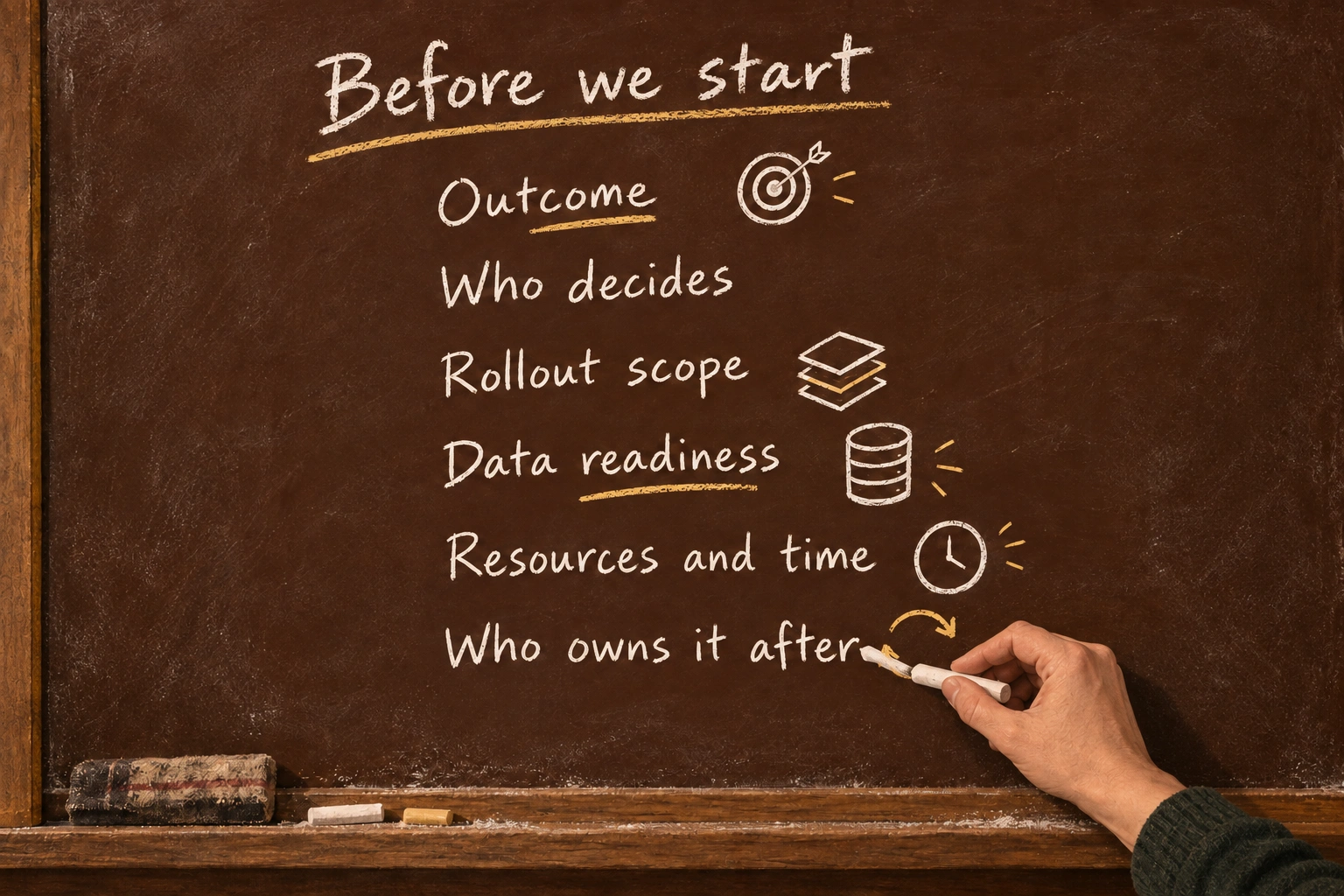
01 Unclear outcome and measures
02 Unresolved decision ownership
03 Big bang rollout dependency
04 Overstated data readiness
05 Resources below the plan
06 No post go-live owner
Which implementation risks are already visible during selection?
A successful demonstration
does not validate the delivery assumptions
A demonstration shows that a product supports a workflow. It does not show that the organisation has agreed what success means, can settle taxonomy and scoring disputes on time, has dependable source data, or can run the platform once the implementation partner leaves. Those conditions drive scope, services, timetable and what ends up in the contract.
Buyer and Project Conditions
What Could Make This Implementation Difficult?
Look at outcomes, decision rights, rollout, data foundations, resources and future ownership. Most of these are visible before any supplier is matched.
Supplier and Delivery Capability
What Support Exists to Manage Those Conditions?
Taxonomy templates, design workshops, migration services and administrator training can help. Whether they help depends on the buyer's condition and on where the contracted delivery boundary sits.
This guidance is for planning a software purchase. Which obligations apply will depend on your organisation's own circumstances.
Six project risks to identify before implementation starts
01 Is the intended outcome clear enough to guide decisions?
02 Are decision ownership and stakeholder participation resolved?
03 Does the implementation depend on a big-bang rollout?
04 Are process, data and integration foundations genuinely ready?
05 Are the delivery assumptions credible for the available resources?
06 Are adoption and post-go-live ownership planned?
Fit-based software matching
Find software that fits how your organisation operates
Tell us what the software must support, how your teams work and which delivery constraints matter. Centvra uses those inputs to build a focused supplier shortlist.
Your operating brief
Fit-based shortlist
Try it with your requirements
Describe your institution in plain language. Only three minutes, no signup to see your matches.
Common questions
- 01. Can a suitable GRC product still lead to a difficult implementation?
Yes. Product fit and project viability are different things. A platform can support the workflows while the project still lacks agreed outcomes, a decision owner for taxonomy and scoring, realistic scope, dependable source data, available second line people, or anyone who owns the platform after go-live.
- 02. Who should own a GRC software implementation internally?
One accountable owner, usually in second line, with authority over methodology and acceptance. That is separate from the project manager who runs the schedule and separate again from IT, which owns the platform, access and integrations.
The harder question is who decides when business units disagree on taxonomy, scoring scales or reporting structure. If that person is not named before implementation starts, those decisions stall in workshops.
- 03. Should we implement all modules at once, or phase them?
Phasing is safer when modules have different owners and different assessment cycles, because it lets you test the methodology in one area before applying it everywhere. A shared deadline or a tightly connected operating model can still justify a broad release.
Risk rises when several modules, entities, migrations and integrations must all succeed together with no readiness gates and no fallback if one is late.
- 04. How long does a GRC software implementation take?
Duration depends far less on the software than on four things the buyer controls:
· How quickly taxonomy, scoring and reporting decisions get made
· How much cleaning and mapping the existing risk, control and obligation data needs
· How many modules and entities are in the first release
· How much time second line experts can give alongside their assessment and reporting calendarTreat any timetable that assumes fast decisions and clean data as an assumption to test, not a plan.
- 05. Should the supplier define our risk and compliance processes?
A supplier or implementation partner can bring templates, workshops and experience from similar projects. The organisation still owns its methodology, scoring scales and control library, because those decisions have to survive audit and regulator scrutiny long after the project closes.
Agree which methods must already exist before configuration starts, which will be decided during delivery, and who approves them.
- 06. How can a buyer test whether the implementation plan is realistic?
Trace the plan through both parties' work:
· Methodology and design decisions
· Data preparation and migration
· Integration design and testing
· Business user validation
· Training, acceptance and transitionFor each one, confirm who owns it, how much time they must give, what it depends on, and whether it sits inside the proposed services or gets charged separately.