

Software · TPRM · Buying guide
How to Choose Third-Party Risk Management (TPRM) Software
Choose third-party risk management (TPRM) softwarefor the risk you manage, not the longest feature list.
Start with your third parties, obligations and operating exposure, then work through each stage in turn.
Key takeaway
The series shows you how to scope your requirements, separate everyday workflow from specialist add-ons such as external risk intelligence, know what to ask during a software demo, reduce procurement delays that eat into your implementation time, and spot the delivery risks that commonly stall TPRM rollouts.
Get These Five TPRM Decisions Right, and Avoid Delay and the Wrong Product.
Start With the StageYou Are In
This is a five-part series covering the whole purchase, from the first view of what you need through to the risks that decide whether the project delivers. Each guide stands on its own, so start with the one that matches the decision in front of you, then check what it depends on.
Choose the CombinationYour Operating Model Needs
You may need stronger assessment and follow-up workflows, richer external risk intelligence, better connections to business response, or a combination. The answer could be one suitable product, an existing platform supplemented with data, or connected specialist systems. Broader exposure does not automatically mean buying a larger suite.
Workflow and Governance
Assessments, approvals, follow-up, evidence and accountability at the scale your team must operate.
External Risk Intelligence
Relevant coverage, timely signals and a clear route from new information to review and action.
Connected Risk Response
Links to business continuity management (BCM), operational resilience, risk, privacy, security and safety processes where the decision depends on them.
Look past the module name. Focus your evaluation on the modules you actually need, and check what each one covers. A module called "risk intelligence" may sound like a match, but if it mainly tracks cyber risk and you need financial health monitoring, it won't meet your requirement. Confirm the risk types each module covers before you count it as a fit. Third-Party Risk Management (TPRM) Software Capabilities covers this in detail.
From Initial RequirementsTo Focused Supplier Conversations
Your first brief is a starting point. Use colleagues, market learning and supplier evidence to make it sharper.
Capture Why You Are Looking
Record the problem, relationships in scope, constraints, deadlines and the outcome that must improve before listing features.
Clarify Initial Questions
Use the FAQs and relevant guidance first. Separate confirmed requirements, assumptions and questions that still need evidence.
Check Priorities With Colleagues
Involve affected service, procurement, security, compliance, privacy, BCM and resilience owners where relevant.
Explore the Market
Use supplier sites, directories, professional recommendations or Centvra to understand available approaches. Treat this as learning, not a final shortlist. You can try Centvra's matching, no sign-up or fee required.
Refine Requirements
Add useful discoveries, investigate confirmed gaps and keep non-negotiable obligations visible rather than making a product fit.
Prepare Focused Conversations
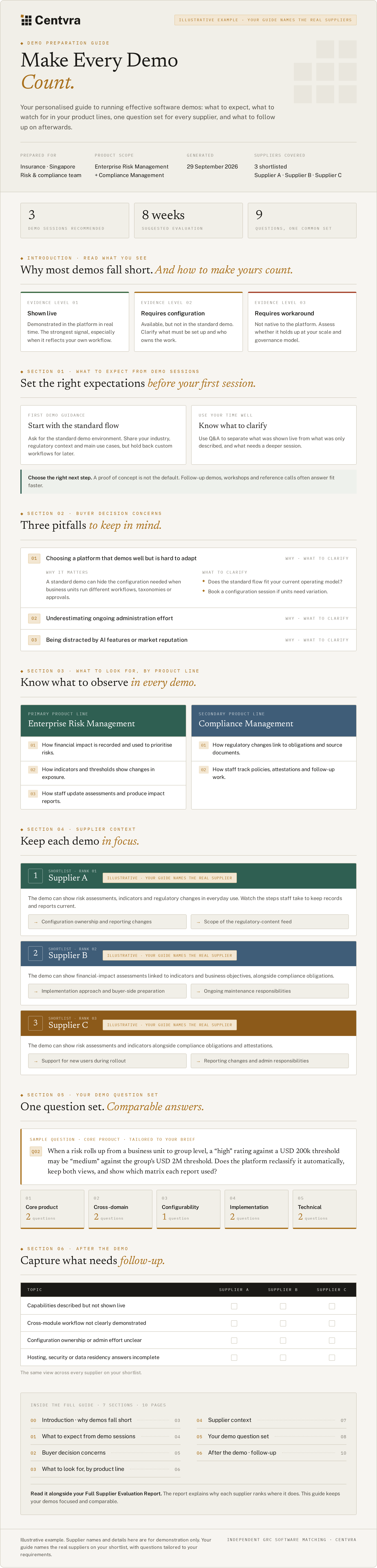
Once suppliers are shortlisted, use one or two realistic, anonymised scenarios in focused follow-up sessions to test fit, limitations and dependencies. Seeing three suppliers or fewer at a time helps avoid demo fatigue.
For more detail, see Third-Party Risk Management (TPRM) Software Requirements for steps A to E, and Third-Party Risk Management (TPRM) Software Demo Evaluation for step F.
The Delivery Clock StartsBefore Implementation
Software procurement can be lengthy and involve several teams, each with its own review process and availability. If the software supports a management commitment or regulatory deadline, the available delivery window is already running while you evaluate and contract.
Evaluate
Request for proposal (RFP) where required, demonstrations and proposal review
Assure & contract
IT due diligence, Master Services Agreement (MSA), Data Processing Agreement (DPA), Statement of Work (SOW) and approvals
Implement
Project team setup, configuration, integration, data migration and testing
Operate
Training, ownership, support and readiness for live use
Plan backwards from operational readiness. Set separate milestones for selection, contract completion, implementation start and live operation. Confirm which activities apply, what documentation is needed and which tasks depend on others.
For more detail, see Why GRC Software Projects Can Take Months to Get Started and Six GRC Project Risks to Identify Before Implementation.
How Centvra Can HelpAlong the Buying Journey
Centvra is one available route. You can also use supplier websites, directories, advisers and professional recommendations as part of your market exploration.
Find Suitable TPRM Options
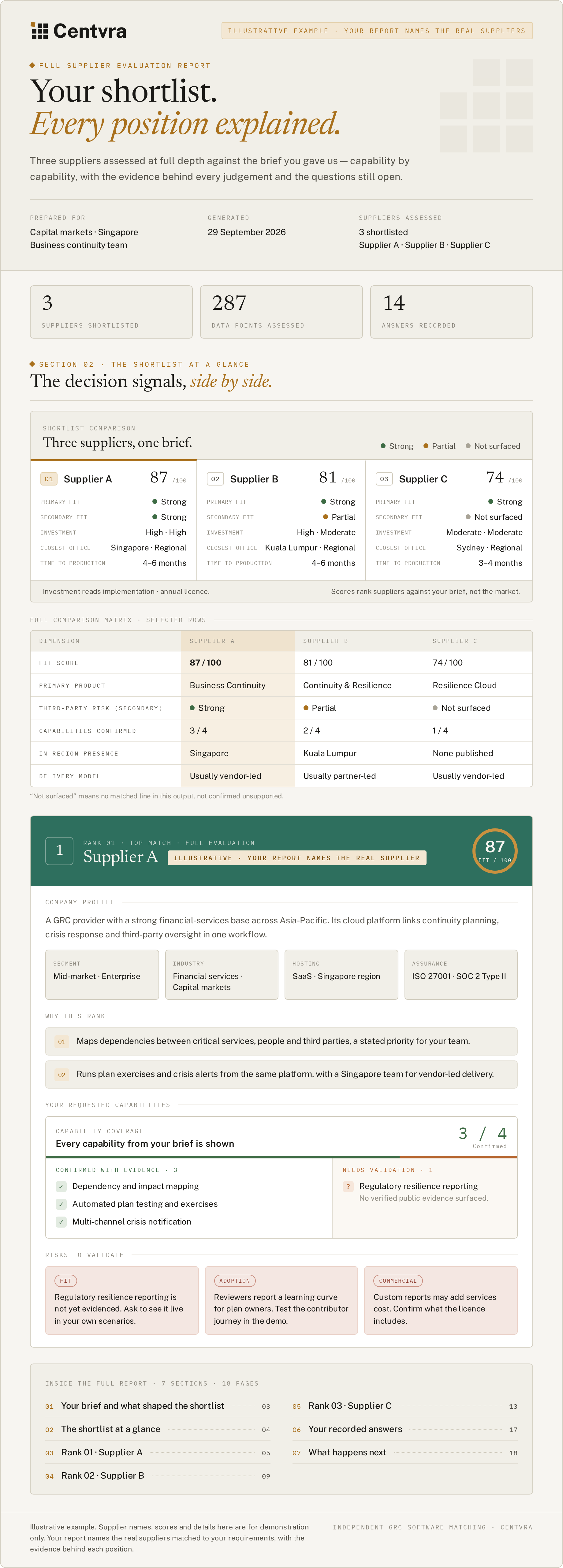
Review Demonstrations
Plan the Buying Journey
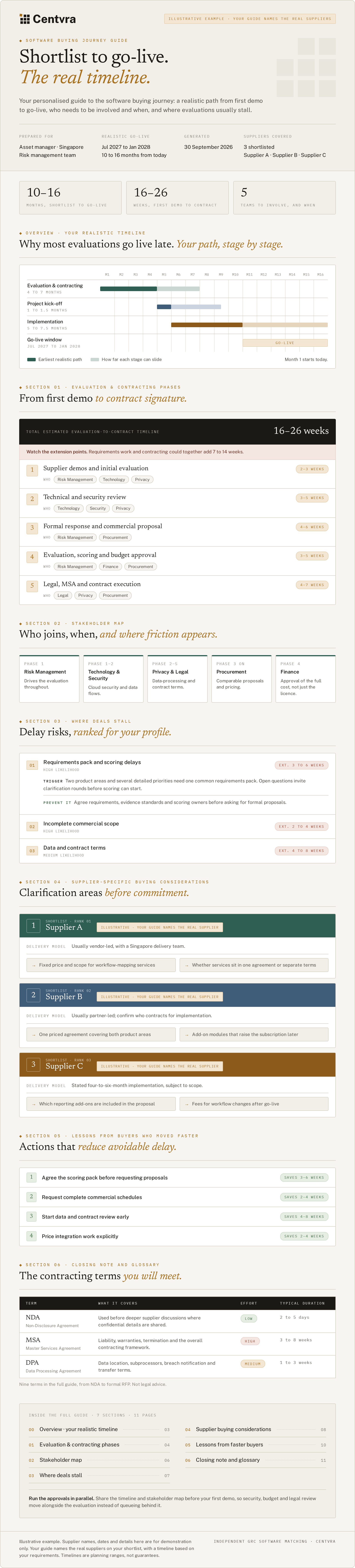
Want a quick estimate first? Try the free Buying Journey Calculator to see how long you have until go-live.
Centvra's view
When TPRM software disappoints after purchase, the cause is often not a missing feature. It's a product chosen on how it looked in a demo, rather than on how well it fits the way the buyer tiers, assesses and monitors its third parties. Identifying each stage's risks is essential to catch that gap early.
Planning reference: This guidance is for planning a software purchase. Which obligations apply will depend on your organisation's own circumstances.
Six Considerations That Should Shape Your TPRM Shortlist
01 · Start With the Problem You Need to SolveStarting point
Identify what prompted the search, such as an audit finding, customer requirement, supplier disruption, expansion into another market or a backlog of reviews.
A team struggling to complete assessments needs to examine workflow. A team discovering supplier problems too late may also need better external information and escalation.
Scale test
Legal entitiesRegionsServices per providerShared ownershipEstablish which assessments, decisions and follow-up actions must work at the volume and complexity you expect to manage.02 · Look Beyond Your Home MarketObligations
Consider where you operate, whom you serve, where services and data processing take place, and which subcontractors support delivery. Requirements can arise directly or through customer contracts.
Cross-border example
A Singapore information and communications technology (ICT) provider serving an EU financial institution subject to the Digital Operational Resilience Act (DORA) can face related contractual requirements through that client without automatically becoming a designated critical provider under the separate oversight framework.
Monetary Authority of Singapore (MAS) bank-outsourcing requirements provide another example in which the institution and arrangement affect the applicable oversight.
Selection consequence: establish obligations with legal or compliance colleagues, then identify the records, reviews and evidence the software should support. A regulatory label on a product is not enough to establish fit or compliance.03 · Assess Disruption in Business TermsOperational impact
Look beyond a provider's registered address to the operating sites, data centres, subcontractors and recovery locations supporting your service.
FrequencyHow often disruption may occurVelocityHow quickly impact reaches youDurationHow long the effect may lastConsequenceCustomers, revenue, cost and commitmentsA rare, sudden event can matter more than repeated minor interruptions. An external supplier score does not establish the financial loss your organisation could suffer because that requires your service and impact information.
Early-warning test: examine coverage, update frequency, alert handling and the connection to people responsible for affected services.04 · Find Where One Third Party Can Stop a Core ServiceConcentration
Some core services depend on a single third party, or on several providers that quietly rely on the same cloud platform, subcontractor or location. When that one point fails, the whole service stops. For example, a bank's card payments, online banking and customer alerts may all run on one cloud provider, so a single outage halts all three at once. A primary provider and its recovery alternative may also operate in the same region.
Ask to see in the demo
Which core services depend on the same provider, platform or locationLinks between primary providers and continuity alternativesThe source, ownership and currency of dependency informationThe limitation: a concentration map is only as useful as the information behind it.05 · Understand the Data Third Parties HandleData handling
Identify what information a provider can access, process or store. Different data types can create different privacy, security and review needs.
CustomerEmployeeFinancialHealthCommercially sensitiveEstablish what privacy and security colleagues need to know, including changes after initial approval. Decide how your TPRM software should record the relevant information, decisions and commitments.
Where the record lives: if another system holds the authoritative privacy or security record, define what TPRM needs to receive or reference instead of duplicating every record.06 · Connect Risk Information With Decisions and ActionConnected response
An alert matters when someone can understand its relevance and respond in time. The information needed for that decision may sit across several functions.
BCMRecovery and alternativesOperational resilienceServices and tolerancesOperational riskRisks, incidents and lossesPrivacy and complianceData and obligationsContractor safetyEnvironment, health and safety (EHS) connection where relevantDemonstration test: show a relevant event, what occurs within the product, what requires another module or system, and where the decision and follow-up are tracked.
Fit-based software matching
Find software that fits how your organisation operates
Tell us what the software must support, how your teams work and which delivery constraints matter. Centvra uses those inputs to build a focused supplier shortlist.
Your operating brief
Fit-based shortlist
Common questions
- Do I need a complete requirements document before looking for TPRM software?
No. Start with the outcomes you need, the third-party relationships in scope, existing systems and known constraints.
A practical starting brief:
· what needs to improve and which third-party relationships matter
· known system, budget, resource and deadline constraints
· confirmed requirements, assumptions and open questionsUse early market exploration to learn what is available and refine the brief with colleagues. Your procurement team can confirm when a formal specification or request for proposal (RFP) is required.
- Who else should review TPRM software apart from the risk team?
The risk team usually leads, but several other teams use the software or depend on what it produces. Their input helps you spot gaps before you choose a supplier.
Teams worth involving:
· procurement, which in many organisations handles third-party onboarding and contracts
· information security, which reviews cyber questionnaires and evidence
· legal or contract management, which tracks contract terms and obligations
· the business owners who manage each third-party relationship day to day
· IT, if the software needs to connect to your existing systemsHow much each team takes part is for your organisation to decide. What matters is that the people who will use the software day to day see it before a supplier is chosen, not after.
Ask the supplier for a recording of the demo afterwards. You can then share it with the teams who couldn't attend and collect their comments.
- Can TPRM software work with our existing GRC, BCM or operational resilience systems?
It may be possible, but an integration listing does not prove the workflow you need.
Define the connection:
· which system owns the supplier, service, recovery or risk record
· what information and actions must move between systems
· who maintains the connection and resolves failed or outdated data
· what additional modules, licences, integration work and support are requiredRequest evidence: ask for a demonstration using the proposed products and connection before relying on the integration in your evaluation.
- What should we prepare before a TPRM software demonstration?
Let each supplier run its standard demo first, then use focused follow-up sessions to test the product against your real work.
Before and between sessions:
· bring a short requirements brief and priority questions
· for follow-up sessions, use one or two anonymised scenarios reflecting actual work
· involve colleagues who will use or support the process
· agree what you need to see and record what remains unverified
· request follow-up evidence where neededRecord the evidence level: separate functionality demonstrated in the current product from proposed configuration, integration work or future roadmap items.
- What if no supplier appears to meet an important requirement?
First distinguish missing evidence from a confirmed product limitation.
Work through it in order:
· verify the evidence and the exact limitation
· explain the outcome you need, not only the requested feature
· assess alternatives, configuration or integration, including cost and operational consequences
· agree internally whether the requirement can changeDo not silently remove a non-negotiable obligation merely to make a product fit. Revisit preferences only where the trade-off is understood and accepted.
- How do we compare what is included in TPRM software proposals?
Ask suppliers to price the same scope and state their assumptions. A total price is not comparable until you know what it includes.
Check each proposal for:
· Product scope: edition, modules, users and third-party limits
· Data and integration: external subscriptions, connections and dependencies
· Delivery scope: implementation, migration, training and support
· Commercial scope: one-off, recurring and renewal costsCompare exclusions, customer responsibilities and renewal assumptions alongside the quoted price. This prevents apparently similar proposals from covering different work.