

Software · ERM · Buying guide
How to Choose Enterprise Risk Management (ERM) Software
Choose enterprise risk management (ERM) softwareso each decision sets up the next.
Get a clear view of the whole journey. Choose software that fits how your organisation works, test what matters before you commit, and set your project up to start well.
Key takeaway
Across the series, you'll learn how to set clear requirements, compare how ERM suppliers really differ, know what to ask in demos, keep procurement on track and spot the delivery risks that commonly derail ERM projects.
Get Five Linked ERM Decisions Right, and Choose Software Your Team Can Deliver
Start With the StageYou Are In
This is a five-part series, and together the guides cover the whole purchase, from the first view of what you need through to the risks that decide whether the project delivers. Each guide stands on its own, so start with the one that matches the decision in front of you, then check what it depends on.
Each Decision ShapesWhat Comes Next
Buying ERM software involves five linked decisions: what you need, which suppliers fit, what the evidence shows, what must be agreed before the project can start, and which delivery risks to address. They can overlap, but each one relies on the last. When a decision is skipped or loses track of an earlier one, the gap often surfaces later, when it costs more to fix.
Leave something usable for the next decision.Each decision should leave more than a meeting outcome. Your buying brief shapes the shortlist, the shortlist shows what suppliers need to demonstrate, and the evaluation record brings out caveats and dependencies. The contract and approvals decide how those are handled, and the delivery plan keeps the conditions your choice was based on.
Treat Delivery RisksAs Inputs to Your Choice
Think about delivery risks from the start. Each one changes a decision you have already made, or are about to make.
Five risks that change an ERM buying decision, not just the project plan.
Unclear goal
Changes your requirements.
Ambitious first rollout
Changes supplier fit and cost.
Limited business input
Makes demo feedback less reliable.
Poor data
Changes what can be migrated and reported.
After go-live
Unclear ownership changes how the system will be run.
Use them as inputs to your choice. Do not leave them for the project team to sort out after signing. Raising them early lets them shape your requirements, supplier choice, contract and delivery plan. For more detail, see Why GRC Software Projects Can Take Months to Get Started and Six GRC Project Risks to Identify Before Implementation.
Apply the GuidesTo Your Own Situation
Our guides explain the approach and the questions to ask. Centvra can then apply them to your organisation's ERM goals, structure, constraints and current buying stage, so you can focus on what matters most for you.
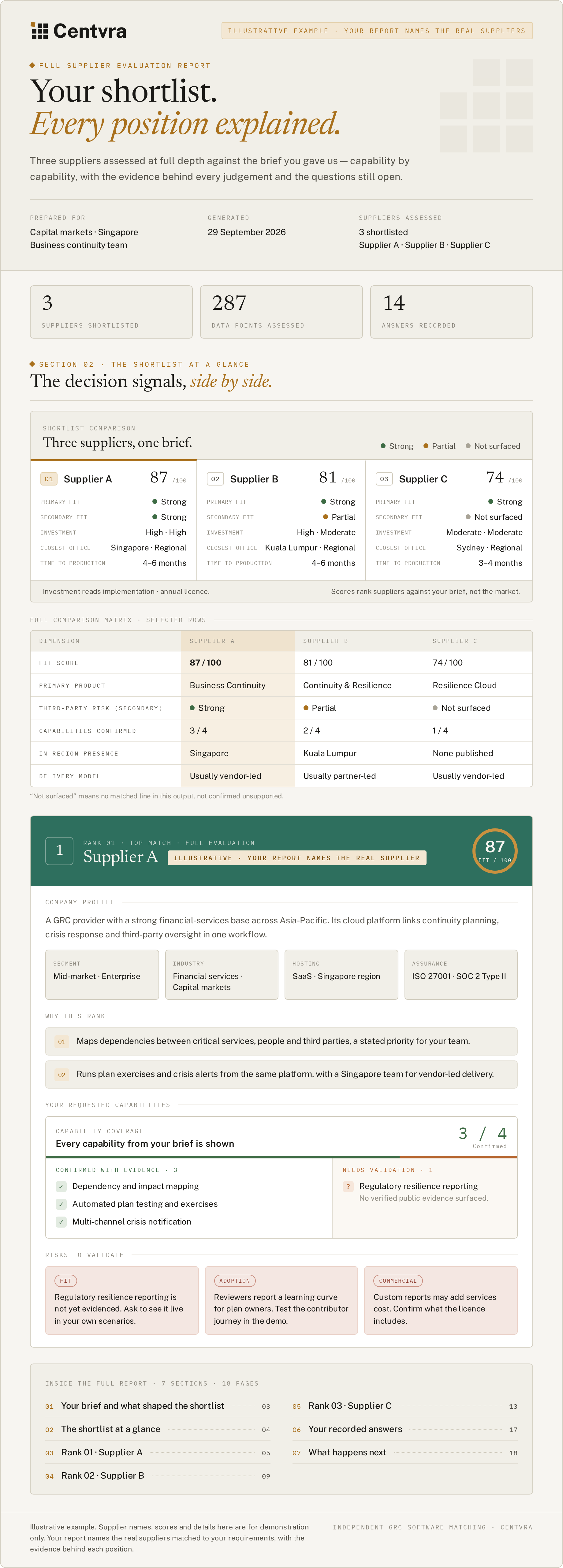
Find Suitable ERM Options
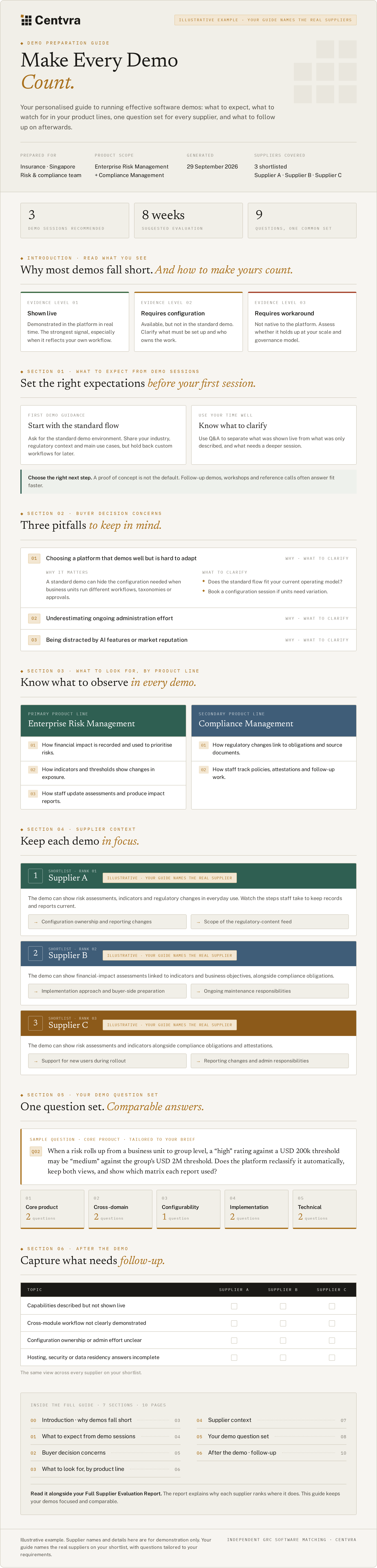
Review Demonstrations
Plan the Buying Journey
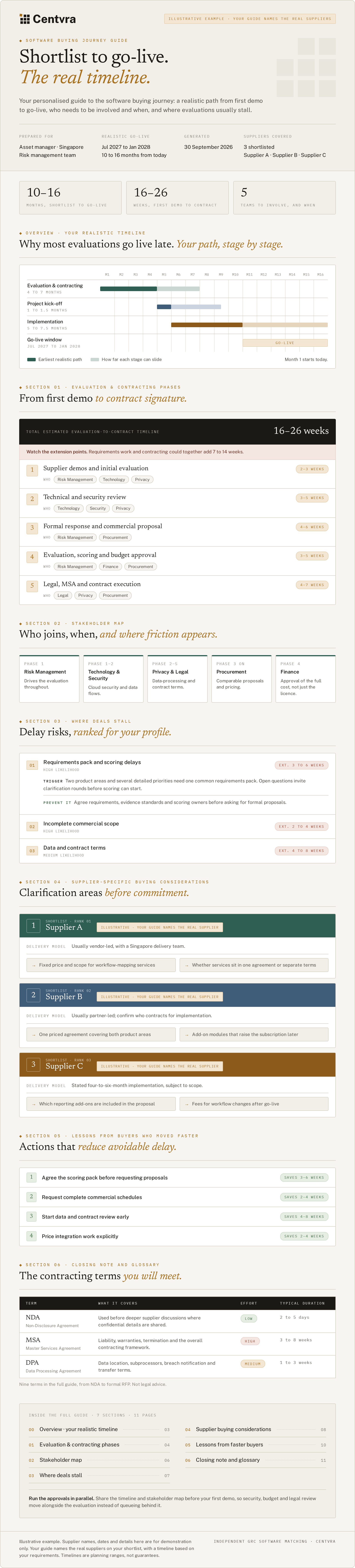
Want a quick estimate first? Try the free Buying Journey Calculator to see how long you have until go-live.
Centvra's view
The aim is not to remove every risk. It is to spot the important ones early enough to shape your requirements, supplier choice, contract and delivery plan.
Planning reference: This guidance is for planning a software purchase. Which obligations apply will depend on your organisation's own circumstances.
Five decisions in the ERM software buying journey
01 · Define and Refine Your Requirements Before Comparing ProductsRequirements
Be clear on what the software must help your organisation decide before you look at products.
Focus
The enterprise decisions, risk information and people the software must support.
Watch for
A preferred feature, workflow or supplier standing in for the real need.
Carry forwardA prioritised buying brief with purpose, scope, stakeholders, constraints and open questions.
02 · Compare Capabilities by Delivery Fit, Not Feature NameCapabilities
Similar feature names can hide very different ways of delivering the same outcome.
Focus
How each supplier delivers the outcomes that matter most to you.
Watch for
Outcomes that need setting up, extra modules, integrations, paid services or a future release.
Carry forwardA shortlist rationale tied to your important requirements, with limitations and dependencies visible.
03 · Turn Supplier Claims Into Comparable EvidenceEvaluation
A good demo is a starting point. Base your decision on what you have actually seen working.
Focus
The supplier's standard demo first, then focused sessions on the requirements that could change your decision.
Watch for
Features that were only explained, need setting up or are still unproven. Consider a formal trial only when your decision genuinely needs one.
Carry forwardAn evaluation record that keeps evidence, caveats and follow-up actions together.
04 · Keep Your Project Kick-off Date Realistic After Choosing a SupplierProcurement
Choosing a supplier does not mean the project is ready to kick off.
Focus
The IT and security checks, contract and data protection terms, statement of work, funding and approvals still ahead.
Watch for
One unresolved item reopening several documents, or a project kick-off date set before the remaining checks and approvals are mapped.
Carry forwardAgreed terms, scope, approvals and a realistic project kick-off date.
05 · Address Delivery Risks Before You Sign, Not AfterImplementation
A suitable platform can still be hard to deliver, so find the risks while you can still act on them.
Focus
The scope, resources and supplier responsibilities you can still adjust before signing.
Watch for
An unclear goal, missing owners or business input, an all-at-once rollout, unready processes and data, a plan that outstrips your people, and no owner after go-live.
Carry forwardA delivery plan, realistic internal resources and clear success measures beyond go-live.
Fit-based software matching
Find software that fits how your organisation operates
Tell us what the software must support, how your teams work and which delivery constraints matter. Centvra uses those inputs to build a focused supplier shortlist.
Your operating brief
Fit-based shortlist
Common questions
- How should risk appetite shape our ERM software requirements?
- It decides what the software must monitor, escalate and report, so agree how you express appetite before you write requirements.
Appetite set as qualitative statements needs different support from appetite set as metrics with thresholds for each risk category or business unit. Clarify who sets and approves appetite, at which levels it applies, which indicators track it and what should happen when a threshold is breached. Those answers shape your requirements for key risk indicators, escalation, exceptions and board reporting. - Do we need advanced ERM features such as Monte Carlo simulation, bowtie analysis or automated KRI feeds?
- Only if your risk maturity, data and team can use them. Most ERM platforms already cover the core functions as standard.
Risk registers, inherent and residual ratings, risk and control self-assessment, appetite tracking, action tracking and standard reporting rarely separate suppliers. Advanced features such as Monte Carlo simulation, financial impact scoring, automated KRI data feeds, external risk intelligence and bowtie analysis do. Before paying for them, check that you have reliable loss or exposure data, source systems that can feed your indicators, and people who will maintain the models and act on the results. - Who from our organisation should attend ERM supplier demos?
- Include the people who will use, run and rely on the system, not only the central risk team.
Business unit risk owners can judge whether assessments and updates fit their day-to-day work. System administrators can gauge the effort needed to configure and maintain it. Senior report users can check whether the group view answers their questions. IT and security representatives can raise integration and access questions early. Agree in advance what each attendee will assess, so feedback stays comparable across suppliers. - Which ERM buying activities do teams most often underestimate in effort and time?
- Negotiating the master services agreement, the main contract, is often the longest back-and-forth. Liability limits, data protection terms, service levels and termination rights are common sticking points, and each round waits on both legal teams.
Other activities that often take longer than planned:
· Your own supplier due diligence: your third-party risk, security and data protection reviews apply to the ERM supplier too, often with long questionnaires and follow-up rounds.
· Data location and hosting checks: where risk data is stored and who can access it may need its own review, especially in regulated industries.
· Scope for a group rollout: agreeing which entities, business units and features go first can take several rounds.
· Document alignment: a change to the contract, statement of work or price can reopen the others.
· Funding and approvals: budget cycles and approval committees run on their own calendar.
Starting these early, and in parallel where possible, protects your project kick-off date. - Why do ERM projects struggle when business units define risk differently?
- Group reporting only works when risks are categorised and rated on a shared basis.
When business units use different risk categories, rating scales or terms, the software may show their risks side by side but cannot compare or combine them reliably. Fixing this after configuration usually means rework. Agree the group taxonomy, rating approach and any allowed local variation before the system is set up. How a platform handles this is usually settled during implementation scoping rather than shown in a standard demo, so ask each supplier directly. - How should our ERM maturity affect the way we buy?
- Buy for the ERM function you have now and the next stage you can realistically reach, not an ideal end state.
A developing function usually gains most from a clear operating model, a consistent risk taxonomy and a phased rollout, with advanced features left for later. A mature function can push harder on group aggregation, appetite monitoring, quantitative analysis and links to operational, third-party and IT risk. Either way, check that the supplier can support your next stage without a disruptive change of platform.