

Software · Logistics · Business Continuity

What to Look For in Business Continuity Software for Logistics

Business continuity management (BCM) plans for logistics often look ready on paper, until one shared system or partner stops several sites at once.

Before you compare software, work out which services, sites and partners depend on each other.

Key takeaway

You'll know which continuity software features matter for your logistics services, what a system does that plans in Word cannot, and what to settle internally before you start meeting suppliers.

Find the Features That Keep Your Logistics Services Running

Who this guide is for

Logistics providers starting to look for a business continuity management system, or thinking about moving on from a manual system.

What you'll come away with
  • Where one shared system, site or partner could stop several services at once
  • Which features matter beyond the basics every product has
  • What a dedicated system changes compared with a manual one
  • What to settle internally before you start meeting suppliers
01 Define the services you need to keep running

Identify the critical services in your operations.Not which departments have plans.

A critical service is one where a disruption would directly affect your customers, and could damage your reputation, breach your contract commitments or, in some cases, lead to regulatory penalties. For a bank, that might be card payments or online transfers; several departments and systems work behind each one, but the customer only sees whether the payment goes through. For a logistics provider, it's the same: order fulfilment, a delivery, a temperature-controlled shipment.

Your software should let you record each critical service and link it to the people, sites, systems, equipment and outside partners it depends on, whichever team holds that information.

Critical service What the customer sees People Site Systems Partners One failure here stops the service above
A critical service sits on top of everything it needs. Departments own the boxes below; the customer only sees the box above.

Warehousing and order fulfilment

If your warehouse management system (WMS) goes down during peak dispatch, can you alert shift leads, drivers and key customers within minutes, and move straight to the recovery steps agreed for that site? Mass notification and site recovery plans should work from the same record of what the site depends on.
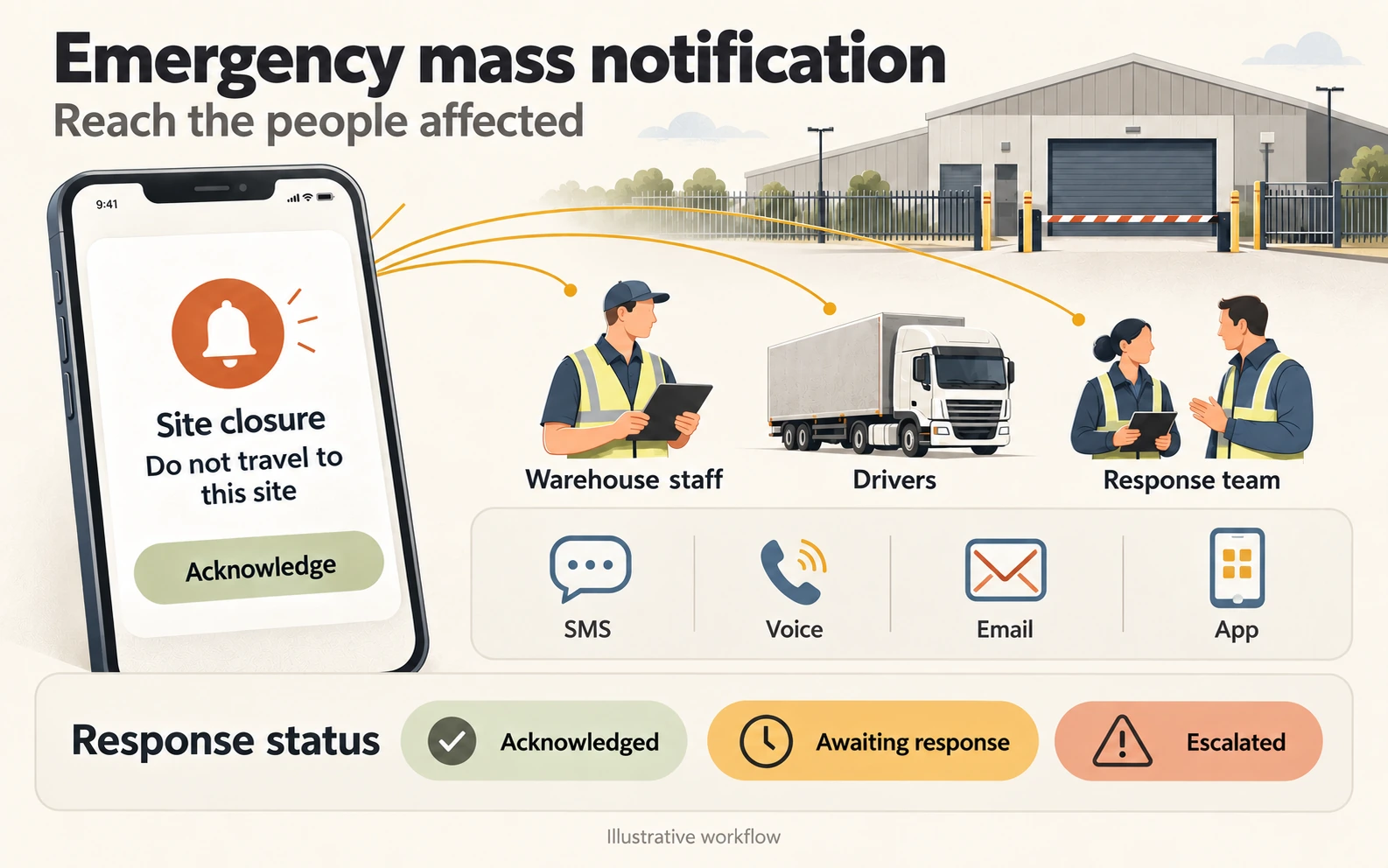
Illustrative site closure alert sent to warehouse staff, drivers and the response team through several channels, with acknowledgements and escalation status.
Illustrative only. An alert reaching warehouse staff, drivers and the response team, with acknowledgements and escalation status. It does not represent a particular product.

Freight and partner hand-offs

If a major carrier or subcontractor can't operate tomorrow, does your business impact analysis (BIA) show which services stop, how long you can hold out, and whether an alternative partner can take the volume? Supplier records and the BIA should answer this together, not from separate spreadsheets.

Time-sensitive and specialist services

If the data centre running your cold-chain monitoring goes offline, will your recovery plan still get temperature-sensitive goods moved within their time limit? The plan should hold those limits and the backup arrangements, so the response doesn't depend on someone remembering them.

What every product should already do. Expect every product on your list to cover the basics: a business impact analysis (BIA), recovery time and recovery point objectives (RTO and RPO), plan storage, contact lists, task checklists, basic reports and mobile access to plans. The real difference is how well a product links these records to the services affected, the response decisions and tested recovery arrangements.
02 Where manual systems run out

Every department has a plan.None of them shows the whole response.

When a disruption crosses every department at once

A major disruption doesn't arrive one department at a time. A regional power outage takes out warehouse refrigeration, depot fuel pumps and your customers' sites at once. A data centre failure takes the WMS, transport management and temperature monitoring together. An oil and gas operator facing a spill has the same problem on a larger scale, with operations, environment, legal and communications teams all responding at once.

When several departments have to act together, plans in Word and contact lists in a spreadsheet leave each team working from its own document, with no shared view of what's happening or what's already been handled. A national telecoms outage makes that worse: the spreadsheet assumes you can still open it and that the usual channels still work.

03 How a BCM system makes a difference

A manual system holds stale information.A BCM system maintains operational readiness.

The disruptions in the last section, a regional power outage, a data centre failure, a national telecoms outage, make the point on their own: none of them can be handled by one department working from its own plan. A BIA maintained in silos was workable when disruptions stayed local. It isn't any more.

The difference a system makes isn't that it stores plans more neatly. It's that the same information does work: it shows the knock-on effect of a failure, alerts the right people, tracks the response as it happens, and proves what was tested. A well-run set of documents can be enough for a single site with few partners. It stops being enough once several sites, systems and partners are involved.

Traces the knock-on effect

Shows what happens downstream when a site, system or partner fails, including the indirect effects a level or two further out.

A spreadsheet can list what each process uses; it can't follow the chain.

Watches external threats against your own sites

Ties weather, hazard and geopolitical feeds to your mapped sites, assets and people, so an emerging threat is matched to what it could disrupt.

Outside your own walls, documents hold nothing.

Alerts everyone at once

Multi-channel alerts by SMS, email, voice and app, with confirmation of who has responded.

Contact lists in a spreadsheet assume someone can open the file and start phoning.

Runs the response live

Mobilises teams, assigns and tracks tasks, logs decisions, and keeps one shared picture of what's happening.

A plan document opened during a crisis can't tell you what's already been done.

Keeps plans current from the underlying data

Builds recovery plans from live impact-analysis and dependency information, so they change when the business changes.

Static documents drift out of date between reviews.

Shows testing actually happened

Schedules and runs exercises, records what failed and tracks fixes to closure.

Exercise notes in separate files can't show a board or a customer that recovery was proven.

Sets a limit on how long a service can be down

Rather than recording a recovery time per system, this defines how much disruption each customer-facing service can absorb before real harm is done. A system holds that limit against the service and brings together the recovery times of everything the service depends on, so a gap is visible rather than buried in separate documents.

Banking regulators now require this because department-level plans couldn't answer the question. Logistics faces the same gap, without the mandate.
04 Before you start talking to suppliers

Most of this work happens before the first demo.It decides which suppliers are worth your time.

You don't need your data loaded into anything to make progress. What you need is a clear view of what every product already does, where products genuinely differ, why your organisation is doing this now, and what your customers, partners and regulators expect of you.

Know the baseline
Every product in this market does the same core things: impact analysis, recovery time targets, plan storage, contact lists, task checklists, reporting and mobile access. Knowing this stops you being impressed by a demo of something every supplier has, and keeps your questions on what actually differs.
Know where suppliers differ
The seven capabilities in the last section are where products separate. Decide which ones you need. Few products are strong across all of them, and some are delivered through a sibling product or an outside partner rather than built in, which affects how well they work together.
Look inward: why now, and who's behind it
What triggered this: a customer audit, an incident, a new contract, a regulator. Is there a named sponsor and budget this year, or is this still exploratory. And can the organisation keep the data current after go-live, because a system with stale data is no better than the documents it replaced.
Look outward: customers, partners and obligations
What your contracts already commit you to, and which customers audit your continuity arrangements. Where your partner concentration sits, meaning which carriers, warehouse operators or subcontractors support more than one of your services. And which regulatory obligations apply to what you move: pharmaceuticals, food, dangerous goods and defence each bring their own.
In the news

In November 2023, a cyberattack forced DP World Australia to disconnect its systems and stop work at its terminals in Sydney, Melbourne, Brisbane and Fremantle. Operations restarted three days later. Clearing the backlog of more than 30,000 containers took another week. The restart was one milestone; working through the backlog was the longer part of recovery.

Source: ABC News, 28 November 2023

You're ready to approach suppliers when you can

  • Name the services where disruption would hurt your customers, and what each one depends on
  • Describe a disruption that would cross several departments at once, in your own operation
  • Say which of the seven capabilities you need, and which you can live without
  • Answer why this is happening now, who is sponsoring it, and whether there is budget this year
  • Explain how the data will stay current after go-live, and which of it has to come in by integration
  • Say how hard it is today to find out which services one provider supports
The last one is the hardest to answer. If nobody in your organisation can, you've just found your strongest requirement.

The considerations below go into each of these in more detail.

Planning reference: This guidance is for planning a software purchase. Which obligations apply will depend on your organisation's own circumstances.

Seven Checks Before You Shortlist

  • 01 · The Trigger Behind the PurchaseTrigger

    Something prompted this: a customer audit, an incident, a new contract, a regulator, or a new head of risk. The trigger sets the deadline, the budget and how much scrutiny the purchase will get. Focus on what has to be true by when, and for whom. Watch for a trigger nobody outside the BCM team feels; it rarely survives budget season.

    System requirement

    If the trigger is an audit or a regulator, the system has to produce evidence on demand, not just hold plans. If it's an incident, response speed matters more than reporting.

  • 02 · The Data Nobody Will Maintain by HandOwnership

    A system is only as good as the sites, systems, partners and contacts inside it, and that information lives with warehouse, transport, IT and procurement. Focus on whether those teams can realistically maintain it by hand, or whether it already lives in systems you run. Watch for trying to mirror every shipment and transaction; keep to the relationships that change a continuity decision.

    System requirement

    Anything your teams won't update by hand has to come in by integration, typically staff contacts from HR or your directory, and assets from an IT register if you keep one. If it can't, it will be stale within a year.

  • 03 · Understand What a Service Failure Actually CostsObligations

    You don't need to read every customer contract. You need a general picture: if you miss a typical service level, what happens? A penalty, a lost contract, a customer audit, reputational damage? Has it happened before, and what did it cost? Focus on the typical consequence and any past precedent, at the level of a service rather than a contract. Watch for turning this into a contract review exercise; that isn't the BCM team's job, and it isn't needed to choose software.

    System requirement

    Only if those consequences need to be visible during a response, or evidenced to a customer afterwards, does the system need to hold commitments against each service. If a missed delivery is simply absorbed, it doesn't.

  • 04 · The Concentration You Cannot Currently SeeConcentration

    The question isn't what your concentration risk is. It's whether you could find out. Try it: name one transport provider and work out how many of your services stop if it fails. If that takes days, or nobody can answer, that's your finding. Focus on how hard the answer is to get today and where it breaks down, for example the same provider recorded under different names across sites. Watch for assuming multiple contracts mean independent alternatives; they may run through the same subcontractor.

    System requirement

    If you can't answer it today, the system must record a provider once, link it to every service that uses it, and show the combined impact. That's a shortlisting criterion, not a nice-to-have.

  • 05 · Confirm Who Needs to Take Part During a DisruptionParticipation

    A response may involve a subcontractor's dispatcher, a warehouse supervisor on another shift and a customer account manager. Many of them aren't on your payroll. Focus on roughly how many people outside your own staff would need to receive, acknowledge or update something. Watch for a per-user price that only becomes clear once partner staff are counted.

    System requirement

    If that number is significant, external participation has to be possible without a paid account, and the pricing model has to survive it.

  • 06 · Check Whether Your Response Depends on What Just FailedAvailability

    A response platform may rely on the same corporate sign-in, network or email affected by the incident. Mobile access on its own doesn't mean independent access. Focus on whether the outage scenarios in your own plans would also take out the tool you'd use to respond. Watch for offline access that displays plans but can't record what was done.

    System requirement

    Independent access and an alternative communication path, sized to the outage scenarios you actually expect, not to a general claim of mobile access.

  • 07 · Get the Full Cost, Not the Platform CostCommercial scope

    A supplier's website may present continuity planning, crisis management, mass notification and threat monitoring as one offering. Often they are separate products, sometimes from an acquisition, sometimes from a partner. Focus on which of the capabilities you need appear to come from the same product, and which sit under a different product name. Watch for a capability that only appears in a separate datasheet or under a different brand.

    System requirement

    If two capabilities you need come from different products, treat how well they work together as a shortlisting question, not a detail to settle later.

Fit-based software matching

Find software that fits how your organisation operates

Tell us what the software must support, how your teams work and which delivery constraints matter. Centvra uses those inputs to build a focused supplier shortlist.

Start matchingFree to use · No paid ranking
Matching modelRequirements-led

Your operating brief

CapabilitiesWhat the software must support
Ways of workingWorkflow, ownership and scale
Delivery constraintsHosting, integration and support

Fit-based shortlist

Matched supplierFunctional fit
Matched supplierOperating fit
Matched supplierDelivery fit

Common questions

When does a logistics provider need dedicated business continuity software?

When your current arrangements can no longer keep up with how many services, sites and partners you have to cover. The usual signs are plans that contradict each other, a shared dependency nobody spotted until it failed, or exercises that never quite get finished.

A single site with few partners can run well on well-maintained documents. The case for a system builds when a disruption would cross several departments at once, because that's when separate plans stop helping. Start from the work your team can't do reliably today, then look at what would fix it.

Do we eventually need business continuity software to link to our existing warehouse and transport systems?

Usually not. Those systems run transactions: orders, movements, stock positions. Continuity planning works at a higher level, on services, sites, systems and partners, and that information changes slowly enough to maintain directly.

The integrations worth having are different ones. Staff contact details go out of date fastest, so a link to your HR system or directory is usually the one that pays off. If you keep an IT asset register, linking that saves duplicate effort too. Start without integrations, see what actually goes stale, then connect only that.

How do we assess concentration when we don't know our partners' subcontractors?

Start with what you know. Take the providers that support more than one of your services and ask them directly which sites, subcontractors and facilities they depend on. Prioritise the relationships where a failure would hit several of your services at once.

When you look at software, check that it can hold confirmed facts separately from assumptions, name an owner for each gap and prompt a review when an arrangement changes. Good software makes uncertainty visible. It can't tell you two providers are independent when the information to prove it doesn't exist.

How does business continuity software differ from third-party risk management software?

Third-party risk management is about assessing and overseeing your providers: how risky they are, whether they meet their obligations. Business continuity is about what happens to your services when one of them stops, and how you recover.

They overlap on the same providers, so decide where provider information is maintained and how changes reach the other side. Some platforms offer both as connected modules; others don't, and you'll be linking two systems.

Do cold-chain operations need extra capabilities?

The difference is that the clock doesn't stop. Temperature and handling limits narrow your recovery options and shorten the time you have to decide, so escalation and authority matter more: who can approve a transfer, who confirms alternative storage or transport is suitable.

Continuity software can coordinate those decisions and keep the record of what was decided and when, which matters if a customer or regulator asks afterwards. Monitoring and quality systems keep doing their own jobs. Check the product and jurisdiction requirements before treating any alternative site or carrier as suitable.